Important things to know
You’ve worked hard to build your technical skills, update your GitHub, and fine-tune your résumé. But when it comes to interviews, especially technical ones, even experienced professionals can stumble. Interviews can feel like an unpredictable test of communication, composure, and problem-solving under pressure. However, most mistakes are completely avoidable once you know what they are.
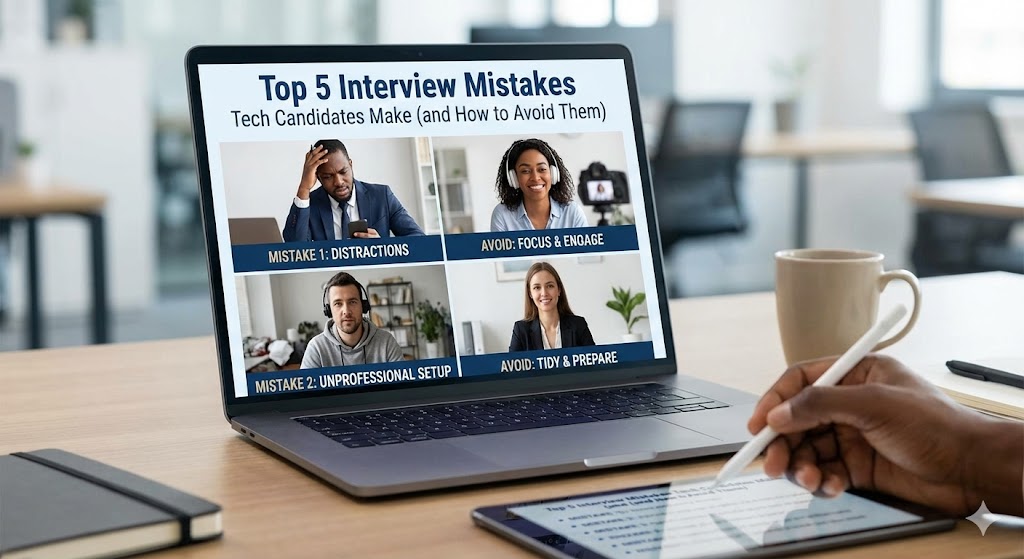
Top-Five Interview Mistakes Tech Candidates Make & How To Avoid Them
Below are five interview mistakes tech candidates make and how to avoid them if you want to ace your next interview.
1. Jumping into problem-solving without clarifying questions
One of the most common pitfalls in tech interviews is providing answers before understanding the problem.
In companies like Facebook (Meta), Uber, and Kensho, interviewers repeatedly emphasize the same thing: "Great candidates ask questions first". Imagine you’re asked something like:
“How would you manage a project that’s running behind schedule due to engineering delays?”
Many candidates jump straight into tactics “I’d reassign resources,” or “I’d update the timeline.” But interviewers are looking for structured thinkers who clarify before acting.
Ask questions like:
“What’s causing the delay, dependencies, scope creep, or resource gaps?”
“How critical is this project to the product roadmap?”
“Do we have flexibility in deadlines or budget?”
“What are the success metrics or must-haves versus nice-to-haves?”
The best candidates don’t just solve fast, they frame the problem clearly.
2. Undervaluing Soft Skills
A common mistake entry-level tech professionals and career switchers make is focusing solely on technical expertise and forgetting that communication and collaboration are part of the job.
Hiring managers want to see how you work with people, not just code, data, or tools. Talk about how you handle feedback, align teams, or translate technical details for non-technical stakeholders.
Technical skills may get you the interview, but your soft skills often land you the offer.
3. Not owning your individual contributions
Tech work is collaborative, but interviews are moments to highlight your role in a team's success.
Too many candidates default to “we” when describing a project “we built the app,” “we fixed the bug.” Recruiters specifically call this out as a red flag. Interviewers need to understand what you did, not just what the team accomplished.
Try reframing:
Instead of saying; “We improved page load speed", say “I led the frontend optimization by implementing lazy loading, which reduced page load time by 40%.”
This subtle shift communicates ownership, accountability, and measurable impact which are all traits hiring managers value in candidates. Watch this video to learn how you can show your value to recruiters to and get hired/sponsored in 2026
If you are struggling with getting a job in the UK because you do not have real-world experience, we have provided a step-by-step guide on what you need to start doing differently. Read it here
4. Being vague or overly technical without structure
When nerves hit, it’s easy to either ramble or hide behind jargon. The result is that your answers lose focus.
Using frameworks like STAR (Situation, Task, Action, Result) helps keep your answers clear and concise. For example:
“At my previous role, our ETL pipeline was failing intermittently (Situation). I was tasked with identifying the root cause (Task). I implemented logging and alerting through Datadog to track job failures (Action), which reduced downtime by 25% (Result).”
This approach shows communication discipline, a trait senior engineers and hiring managers appreciate as much as technical skill. You can be a part of our free community to have exclusive access to weekly career growth resources and webinars. Click here to join.
5. Not doing meaningful research on the company
Even in highly technical roles, interviewers expect you to understand the company’s mission, culture, and products. Before the interview:
- Read the company’s About page and tech blog.
- Check recent product launches, tech stack updates, or funding announcements.
- Look up your interviewer’s background on LinkedIn to understand their focus areas.
These will help you tailor your answers and ask smart, specific questions at the end. Insightful questions make you memorable and signal that you’re evaluating the company with intention, not desperation.
Never forget that landing a tech role requires that you demonstrate clarity, communication, and composure. The best candidates show they can collaborate, reason through challenges, and continuously learn.
Take our 1 minute free Job Readiness Test to know if you are actually ready for your next interview
Click this link to take the test and your score will be all the insight you need.