Important things to know
If you’re choosing between a Security Operations Centre (SOC) path and Ethical Hacking in 2026, you’re deciding how you want to defend the same mission: protecting systems and data. This guide breaks down the seven differences so you can pick the path that fits your skills, personality, and goals.
TL;DR
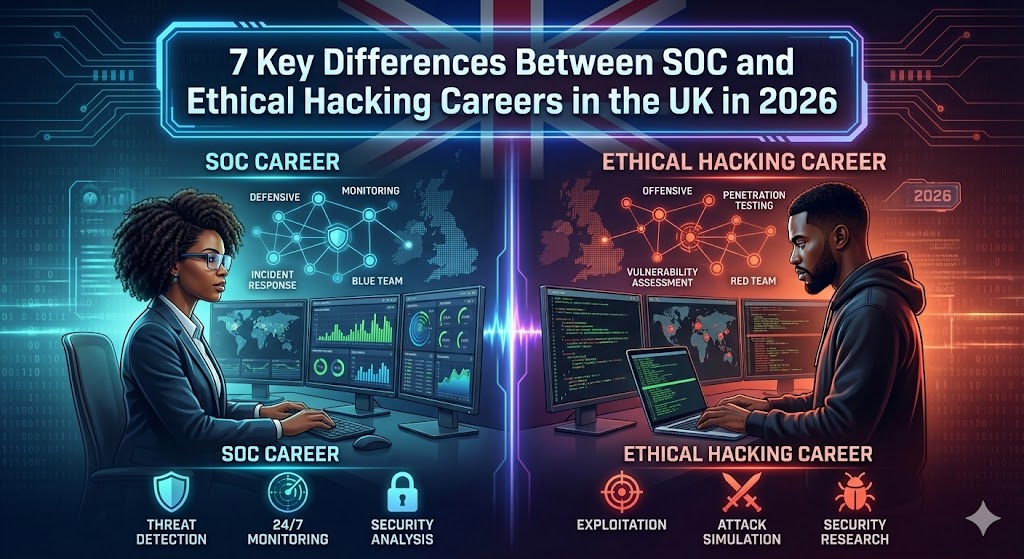
(1) Nature of work: SOC is reactive defense in real time; Ethical Hacking is proactive testing before attackers do.
(2) Day-to-day: SOC Analysts work with dashboards and monitor incidents; Ethical Hackers run scoped tests and write findings.
(3) Skills & learning: SOC analysts focus on monitoring networks and interpreting logs; ethical hackers focus on understanding vulnerabilities, exploitation, and scripting.
(4) Environment: SOC is team-based, structured, with 24/7 coverage; ethical hacking is flexible and project/consulting-friendly.
(5) Growth: SOC careers commonly progress into incident response, threat hunting, and management. Ethical hacking careers often lead to red teaming, consulting, or security architecture.
(6) Salary & demand (UK, 2026): Strong demand for both; Ethical Hacking tends to edge higher on average.
(7) Mindset fit: SOC suits calm, process-driven professionals; ethical hacking suits curious, creative problem-solvers who like to ethically “break” things.
So, let's hop right in!
Nature of Work: Reactive vs. Proactive Security
At their core, SOC analysts and ethical hackers serve the same mission. One is reactive; the other is proactive.
SOC analysts defend in real time, monitoring, detecting, and responding to threats with speed and vigilance.
Ethical hackers take the offensive, simulating attacks to expose weaknesses before criminals can, using creativity and adversarial thinking.
Day-to-Day Responsibilities
SOC Analysts spend their time in front of dashboards, scanning through security alerts, logs, and incidents using tools like Wazuh, Splunk, or Microsoft Sentinel. They investigate anomalies, triage alerts, and coordinate with other teams to mitigate risks.
While ethical hackers live in a world of controlled chaos. Their day might start with reconnaissance, probing a network for vulnerabilities, and testing security systems using tools such as Burp Suite or Metasploit. They end their day by documenting findings and recommending fixes.
Here is a tip: if you enjoy solving puzzles under pressure and thrive in structured environments, SOC work fits like a glove. But if you love creativity, curiosity, and experimentation, Ethical Hacking might be your perfect match.
Skill Sets and Learning Paths
While both roles demand strong cybersecurity foundations, their technical directions diverge.
SOC Analysts rely heavily on skills in network monitoring, incident response, and log analysis. They must understand how systems communicate, how attacks unfold, and how to spot the subtle signs of compromise.
Ethical Hackers need a deeper understanding of vulnerabilities, exploitation techniques, and scripting languages like Python or Bash. Their world revolves around testing boundaries and learning how to outsmart security systems ethically, of course.
For those starting out, certifications such as CompTIA Security+ or ISC2 CC provide solid grounding for SOC roles. Ethical Hackers often begin with CEH (Certified Ethical Hacker) or OSCP (Offensive Security Certified Professional) to build credibility and technical depth.
Work Environment and Collaboration
SOC teams operate in high-energy, fast-paced environments where collaboration is key. Analysts work side by side, sometimes around the clock ensuring continuous protection. The atmosphere is structured, with clear workflows and defined escalation paths.
Ethical Hackers enjoy more flexibility. They might work independently, consulting for different organizations, or collaborate as part of Red Teams that simulate full-scale cyberattacks. Their work is often project-based, combining research, creativity, and problem-solving.
Here is another tip: If you thrive on teamwork and structure, SOC is ideal. If you value independence and innovation, Ethical Hacking gives you the freedom to explore.
Career Growth Opportunities
SOC professionals often begin as analysts and progress into roles such as Incident Responder, Threat Hunter, or SOC Manager. Over time, they may transition into leadership or specialized positions in areas like threat intelligence or cloud security.
Similarly, Ethical Hackers usually start as junior penetration testers before evolving into Red Team operators, security consultants, or even cybersecurity engineers. Their technical depth opens doors to roles in offensive security and security architecture.
Salary and Job Demand in the UK (2026 Outlook)
According to Indeed and Glassdoor, the average salary for a SOC Analyst in the UK ranges between £42,000 and £47,000 per year. Interestingly, Indeed shows that Ethical Hackers command a slightly higher average salary of around £50,000 per year.
Additionally, reviews from the National Cyber Security Centre (NCSC) show that demand for both SOC analysts and ethical hackers continues to rise as digital transformation accelerates across sectors. Whether you’re monitoring real-time incidents or conducting penetration tests, you’ll enjoy career security, flexibility, and the satisfaction of meaningful work.
Last, but not least,
Mindset and Personality Fit
SOC Analysts excel in structured, high-pressure environments where every second counts. They think analytically, communicate clearly, and love solving puzzles that keep systems secure.
Ethical Hackers are natural explorers; they are curious, inventive, and never satisfied with ‘good enough’. They thrive on understanding how systems break and how to make them unbreakable.
If you’re disciplined, detail-oriented, and calm under pressure, the SOC route will challenge and reward you.
If you’re curious, creative, and love the thrill of discovering the unknown, Ethical Hacking might just be your calling.
Final thoughts,
Two Roads, One Mission: Cybersecurity Defense
At the end of the day, both SOC Analysts and Ethical Hackers are on the same team, they’re the guardians of our digital world. Whether defending live systems or stress-testing them to find weaknesses, each plays a vital role in building a safer cyber future.
The best part?
There’s no wrong choice.
Both paths offer challenge, purpose, and the chance to grow in one of the world’s most dynamic industries. What matters most is choosing the one that aligns with who you are and then committing to becoming the best at it.
Are you ready to get hands-on experience in any of these fields?
Join AMDARI’s Cybersecurity Work Experience Program to develop real-world skills with industry-standard tools and gain the confidence to thrive as either a SOC Analyst or an Ethical Hacker.
We have provided more information about our SOC Analysis work experience program here. You can also find out more about our Ethical Hacking/Penetration Testing work experience program here