Important things to know
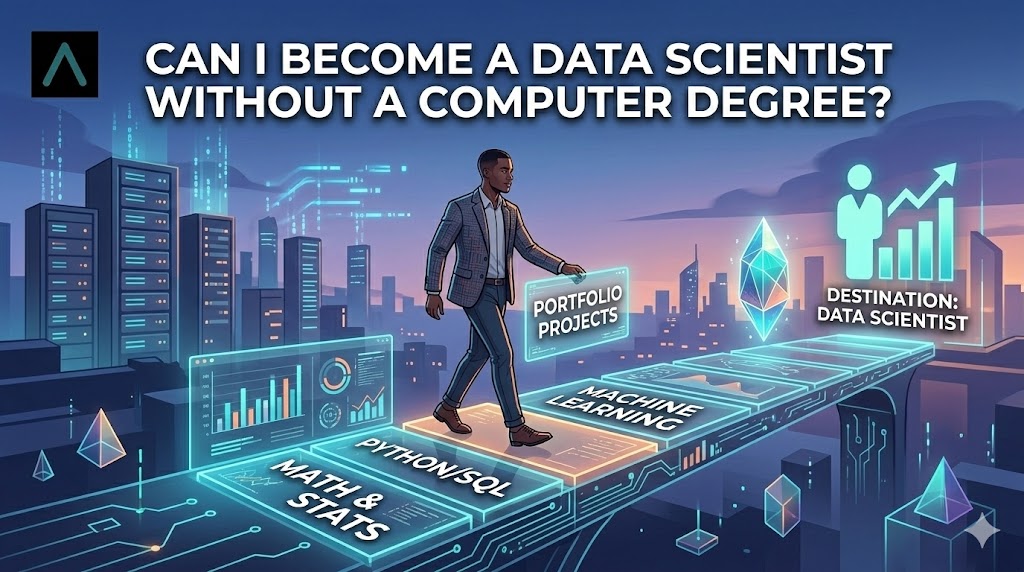
There’s a common myth that you need a computer science degree to break into data science. In the UK, US or Canada that simply isn’t true.
Many successful data scientists come from maths, physics, economics, psychology, engineering, life sciences, and even non-technical backgrounds such as business or marketing. The international job market values people who are positioning themselves with the right skills on both the technical and non-technical side.
If you’re trying to start a data science career in the UK, US and Canada without a Computer Science degree, the path is absolutely possible. It just requires a smart strategy.
1. Understand what employers actually want
A lot of beginners assume data science is mainly about advanced machine learning. In reality, most entry-level roles focus on a more practical mix of skills:
- SQL for querying data
- Python or R for analysis
- Statistics and experimentation
- Data cleaning and exploratory analysis
- Communication and storytelling
- Business understanding
- Machine Learning Operations (GIT, DOCKER, CLOUD PLATFORMS e.t.c)
In many UK< US & Canadian companies, especially outside big tech, hiring managers are looking for someone who can take messy data, find useful patterns, and explain them clearly. That means domain knowledge and problem-solving can matter just as much as a technical degree.
A psychology graduate who understands experiments, or an economics graduate who understands modelling, may already have advantages that employers value.
2. Use your current degree as an asset, not a weakness
Not having a CS degree does not mean starting from zero. It means positioning your background properly.
For example:
- Maths or physics: strong quantitative reasoning
- Economics: statistics, forecasting, and data interpretation
- Psychology: experimental design and behavioural insight
- Biology or healthcare: research methods and real-world data experience
- Business or marketing: commercial awareness and stakeholder communication
Your goal is to connect your existing strengths to data science rather than apologising for what you lack.
Instead of saying, “I don’t have a technical background,” say, “My background in economics gave me a strong foundation in statistical thinking and working with real-world datasets.”
That shift in language and mindset matters more than you can imagine.
This tech professional and Founder transitioned from a law career with no computer science degree. In this episode of our podcast, he shared all the tea that you need to boost your confidence as a career switcher.
3. Learn the core skills that open doors
You do not need to master everything before applying for jobs. You do need a solid foundation.
Focus on these areas first.
SQL
SQL is one of the most underrated skills for aspiring data scientists. In many UK employers, it is used daily and often matters more than fancy machine learning projects.
Learn how to:
- Filter and join tables
- Aggregate data
- Use case statements
- Work with subqueries and window functions
If you can write clean SQL and explain your logic, you will already stand out.
Python
Python is the most common programming language in data science. Start with the basics and then focus on practical libraries such as:
- pandas
- numpy
- matplotlib
- scikit-learn
Do not get stuck trying to become a software engineer. Learn enough Python to clean data, analyse trends, build simple models, and present findings.
Statistics
You do not need a PhD-level understanding of statistics for entry-level roles. But you should be comfortable with concepts like:
- Averages and distributions
- Correlation versus causation
- Hypothesis testing
- Confidence intervals
- Regression basics
- Bias and sampling issues
A lot of employers want people who can think statistically, not just run code.
Data visualisation and communication
The best analysis is useless if nobody understands it. Learn how to present insights clearly through charts, dashboards, and concise writing.
Tools like Excel, Tableau, Power BI, and Python visualisation libraries can all help. More importantly, learn how to answer the question: “So what?”
Machine Learning Operations (MLOPs)
Most companies, especially startups, require that you as the data scientist handles the full data science or machine learning life cycle, including inferencing and taking your model to production.
Tools like Git for version control, mlflow for model tracking and experimentation, cloud platforms for hosting your model and applications, prometheus for monitoring after deployment, dash for interactive dashboard, are necessary for having your trained models serving the target audience.
4. Build a portfolio that proves you can do the work
If you do not have a CS degree, your portfolio becomes even more important. It gives employers evidence.
A strong portfolio should show:
- Real datasets
- Clear business questions
- Structured analysis
- Sensible conclusions
- Readable code
- Brief written explanations
You do not need ten projects. Two to four good ones are enough.
Examples of strong beginner portfolio projects include:
- Analysing UK housing prices
- Exploring NHS or public government datasets
- Predicting customer churn for a fictional company
- Examining retail sales trends
- Building a simple dashboard from public data
Each project should answer a practical question, not just demonstrate random techniques.
A weaker project says, “I used five machine learning algorithms.”
A stronger project says, “I analysed a customer dataset to identify the factors most linked to churn and suggested three retention strategies.”
See more data science projects that you can work on here.
5. Tailor your CV for the UK, US & Canada market based on your interest
A generic CV will not work well, especially if you are changing careers or coming from a non-CS background.
Your CV should make three things obvious within seconds:
- You have relevant technical skills
- You have worked with data in some form
- You can solve business problems
A few practical tips:
- Put technical skills near the top
- Mention SQL, Python, Excel, Tableau, Power BI, or statistics clearly
- Quantify results where possible
- Link to GitHub or a portfolio site
- Rewrite bullet points to emphasise data work, even from non-data roles
For example, instead of:
“Supported marketing campaigns”, write: “Analysed campaign performance data in Excel to identify trends and improve targeting efficiency”. That sounds far more relevant.
7. Do not underestimate networking
A lot of early-career opportunities in data come through visibility, referrals, and community involvement.
You do not need to become a full-time content creator. But you should aim to be findable and engaged.
Good starting points include:
- Improving your LinkedIn profile
- Sharing a project breakdown
- Attending UK data meetups
- Joining online analytics communities
- Connecting with recruiters in data and analytics
- Messaging professionals for short, thoughtful conversations
When your background is unconventional, networking helps people see the person behind the CV.
8. Be ready to explain your story confidently
If you do not have a CS degree, interviewers may ask about your path. This is not necessarily a bad sign. Often they just want to understand your motivation.
Prepare a simple, confident story:
- What your background is
- Why you became interested in data
- What skills you built
- What projects you completed
- Why you are ready now
Keep it focused and positive.
For example:
“I studied psychology, which gave me a strong foundation in statistics and experimental design. While working in operations, I became increasingly interested in using data to solve business problems. I then built my SQL and Python skills through practical projects, including an analysis of customer retention data, and now I’m looking for a role where I can combine analytical thinking with hands-on data work.”
That is a much stronger answer than sounding defensive about your degree.
9. Avoid the trap of endless learning
Many aspiring data professionals spend months or years collecting courses without applying for jobs.
At some point, more learning becomes procrastination.
A better approach is:
- Learn one skill
- Build one project
- Apply it
- Put it on your CV
- Start applying
You do not need to feel fully ready. Most people never do.
The goal is not perfection. The goal is momentum.
10. Think long term
Starting a data science career without a CS degree may take persistence, but it is far from impossible.
Your first step may be a data analyst role. Your first projects may be messy. Your first applications may get ignored. That does not mean the plan is failing. It means you are building a career the realistic way.
What many people don't know is that experience matters more than degree labels. Once you can show that you can work with data, communicate insights, and deliver value, the question of whether you studied computer science becomes much less important and ypur chances increase in a crowded market where the majority have only training and no eperience. This is why many people, especially African immigrant are grateful to have undergone a work experience program that builds their confidence and projects. Learn more about this program here.