Important things to know
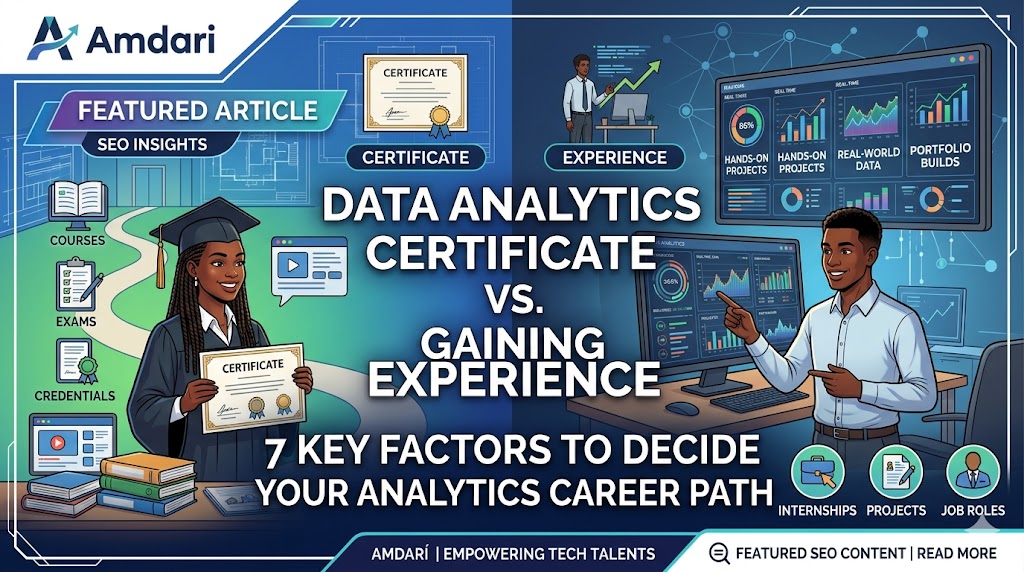
If I were starting out in data analytics today, one of the biggest questions I would ask myself is this: Should I get a certificate, or should I focus on getting an internship?
It is a fair question, especially because both options seem valuable on the surface. A certificate can help me learn the foundations of data analytics, while an internship or experience gives me the chance to work in a real professional environment. But if the goal is to become truly job-ready, I believe one stands out more than the other.
Both certificates and internships matter. However, when it comes to building the kind of experience employers really want, an internship is the better choice, not the kind of internship where you are an errand boy/girl but internship as a service where you get a low-risk work environment structure to work on projects, get supervision from paid specialists, mentorship and other job-readiness services.
Why Certificates Matter
Let me start by saying that certificates are not useless. In fact, they can be very helpful, especially for beginners. A data analytics certificate often introduces important concepts such as data cleaning, data visualization, Excel, SQL, Python, dashboards, and business intelligence tools. It can give me structure, direction, and proof that I have invested time in learning the field.
For many people, certificates are also a confidence booster. They help me say, “Yes, I understand the basics of data analytics.” That matters, particularly when I am switching careers, exploring the field for the first time, or trying to show commitment to learning.
Certificates also have another advantage: they are accessible. I can complete them online, often at my own pace, and they usually cost less than a degree program. If I do not yet have experience, a certificate can be a good place to begin because it helps me build theoretical knowledge and understand the language of the profession.
But here is the truth: knowing something in theory is not always the same as being able to do it in practice.
The Limitation of Certificates
A certificate may tell an employer that I have learned about data analytics, but it does not always prove that I can apply that knowledge to real business problems. I may know how to write a query, build a chart, or explain statistical concepts, but can I work with messy datasets? Can I meet deadlines? Can I collaborate with a team? Can I communicate findings clearly to stakeholders who are not technical?
These are the kinds of things that often separate someone who has studied data analytics from someone who is actually prepared to work in it.
That is why certificates, while valuable, are usually not enough on their own. They show I have learned. They do not always show I have performed.
Why Work Experience Matter More
If I had to choose the option that gives a job seeker the strongest advantage, I would choose an internship every time.
Why? Because an internship takes learning out of the classroom and puts it into the real world.
In an internship, I am not just reading about datasets, I am working with them. I am not just watching tutorials on dashboards, I am helping build reports that may influence real decisions. I am not just practicing with sample problems, I am solving actual business challenges.
That kind of exposure changes everything.
An internship teaches me what no certificate can fully teach on its own: how work actually happens. I begin to understand workflows, expectations, teamwork, communication, feedback, problem-solving under pressure, and how to translate raw data into insights that matter.
This is where practical prowess becomes more important than theory. Employers are not only looking for people who know data analytics terms; they are looking for people who can use data effectively in real situations. When I complete an internship, I come away with stories, projects, experience, and examples I can discuss in interviews. That makes me more believable as a candidate.
Real Projects Build Real Confidence
One of the biggest advantages of internships is that they let me work on real projects. And that matters more than many people realize.
Real projects are rarely neat and straightforward. Data may be incomplete. Stakeholders may change their minds. Deadlines may shift. Business goals may evolve. Through an internship, I learn how to adapt. I learn how to ask better questions. I learn how to think like an analyst, not just study like one.
This kind of experience builds a deeper form of confidence. It is one thing to say, “I completed a certificate in data analytics.” It is another thing entirely to say, “I worked on a live project, cleaned a messy dataset, created a dashboard, and presented insights that supported decision-making.”
The second statement carries more weight because it reflects action, not just instruction.
What Employers Often Notice First
From an employer’s point of view, practical experience is often a strong signal of readiness. A certificate may get my resume noticed, but an internship helps prove I can contribute from day one.
When employers compare candidates, they often ask: Who has applied their skills? Who has worked in a team? Who understands professional expectations? Who has handled real tools in real situations?
That is why internships are so powerful. They reduce the gap between learning and employment. They give me not just knowledge, but evidence.
And in a competitive job market, evidence matters.
So, Should I Ignore Certificates?
Not at all.
If I am being honest, the best path may not be choosing one and rejecting the other completely. A certificate can lay the foundation, and an internship can build on it. But if I must decide which one gives me the stronger edge as a job seeker, I would still choose the internship.
Why? Because data analytics is a practical field. It is not enough to know concepts; I need to show I can apply them. Theoretical knowledge is useful, but practical experience is what turns learning into employability.
So yes, certificates matter. They show I have studied.
But internships matter more. They show I have done the work.
If I were advising any aspiring data analyst today, I would say this: learn the theory, but do not stop there. Go where the real work is. Put yourself in environments where you can handle real datasets, solve real problems, and contribute to real projects. That is where growth happens. That is where confidence is built. And that is often where opportunities begin.
For anyone serious about breaking into data analytics, the smartest move is not just to collect credentials, but to gain hands-on experience that employers can trust. And sometimes, the right platform can make that first step easier, especially one that helps connect aspiring analysts with meaningful internship opportunities, like Amdari. Watch testimonials here.
Speak to a member of the team (for free) here to find out how we can help you.