Important things to know
Chances are, if you've spent much time looking through job openings recently on any number of platforms such as LinkedIn, Reed, or Glassdoor, that you've come across the terms 'data analytics' and 'business analytics'. They appear interchangeable by recruiters, in job postings, and even from industry professionals.
However, the two are not one and the same. If you are considering making a career move or simply wish to hire the appropriate talent for your team, knowing the difference truly matters.
It is time to demystify the confusion.
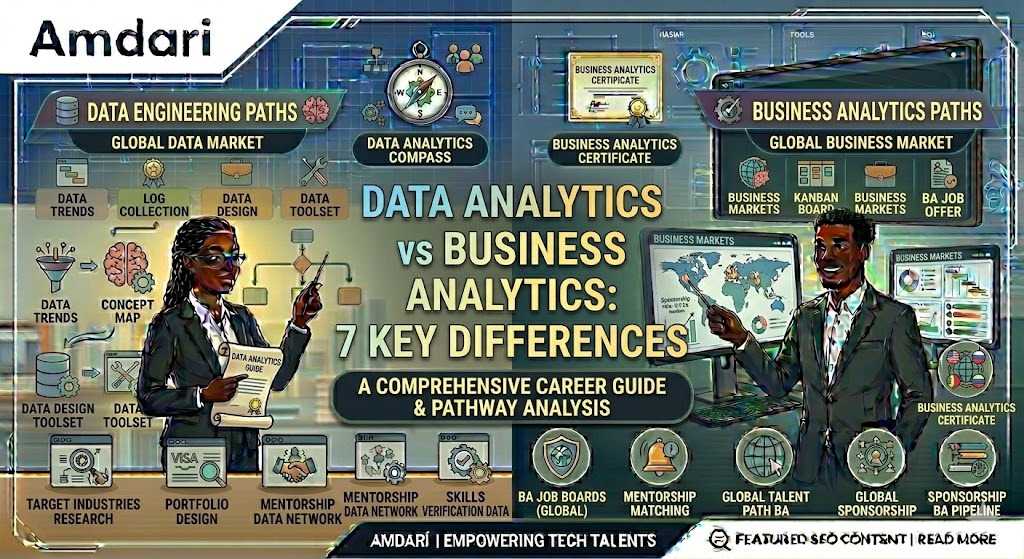
In simpler terms, data analytics can be described as the art of doing things with data, such as cleansing, modeling, and interpreting. On the other hand, business analytics involves applying the insights obtained from data analysis to influence decision making and planning. While one may be more technically oriented, the other one is rather strategically inclined. Both are important, but none is "superior."
Nonetheless, here are the seven critical distinctions to consider.
1. The Core Focus
Data analytics is inherently concerned with the data at hand. Analysts are interested in such queries as: What story does this dataset tell? Are there any trends here? Which aspects are significant from a statistical point of view?
On the other hand, business analytics turns the attention to actions based on the information that is provided by data. The question here is not "What?" but "How to act accordingly?"
Thus, a data analyst for a UK-based retail bank would be working on models for finding anomalies in transactions on a daily basis, whereas a business analyst could use this information to craft a novel strategy with the risk department.
2. Technical Skill Requirements
It’s here that the two fields seem to diverge most explicitly, particularly when crafting a CV.
Data analytics roles in the UK almost always expect proficiency in tools like Python, R, SQL, and platforms like Tableau or Power BI. There's a statistical literacy expected: confidence intervals, regression models, data wrangling, maybe even machine learning fundamentals.
Business analytics roles tend to value these skills too, but the emphasis shifts. You might be expected to work in Excel at an advanced level, use tools like SAP or Salesforce, and be comfortable building business cases and translating data outputs for non-technical stakeholders. The ability to tell a compelling story from a dataset often matters more than how elegantly you built the model.
3. Who They Work With Day-to-Day
Data analysts are usually much closer to data engineers or technology-related functions than they are in most countries. They have relationships with data scientists, developers, and database managers. They make contributions toward the decision-making process but do not necessarily contribute to it as much.
Business analysts, on the other hand, spend most of their time in boardrooms alongside marketing directors, operational heads, and finance departments. They are essentially trying to translate what they know into information that will move a conversation forward at the board level. This requires as many soft skills as technical knowledge.
4. The Types of Questions Each Discipline Answers
Here's a useful mental model. Data analytics tends to answer descriptive and diagnostic questions:
- What happened?
- Why did it happen?
- What trends are we seeing in the data?
Business analytics edges further into predictive and prescriptive territory:
- What is likely to happen?
- What should we do about it?
- Which option gives us the best return?
Of course, there's plenty of overlap but when you see a job spec asking for "scenario modelling" and "strategic recommendations," that's business analytics language. When it's asking for "pipeline development" and "ETL processes," that's data analytics territory.
5. Industry Demand in the UK
Both disciplines are in strong demand across the UK, but the sectors vary somewhat.
Data analytics roles are heavily concentrated in technology, fintech, healthcare, and retail which are areas where massive datasets need to be processed and interpreted at scale. Companies like HSBC, AstraZeneca, and the NHS have significant data teams doing exactly this kind of work.
Business analytics tends to be stronger in consulting, financial services, FMCG, and professional services. Firms like Deloitte, PwC, and McKinsey's UK offices regularly recruit for business analyst roles that sit at the intersection of data and strategy.
That said, since the pandemic, hybrid roles have become far more common. Many mid-sized UK companies want someone who can do both of crunch the numbers and communicate the implications.
6. Career Pathways and Progression
If you start in data analytics, a natural progression often runs through senior analyst → data scientist → machine learning engineer or head of data. It's a technical ladder, and moving up usually means going deeper into statistical modelling, coding, or architecture.
Business analytics careers often climb differently. From business analyst, many professionals move towards product management, strategy consulting, operations leadership, or even the C-suite. The skills you build include stakeholder management, commercial thinking, cross-functional communication which translate broadly.
In the UK context, it's worth noting that the Chartered Institute of Management Accountants (CIMA) and BCS (The Chartered Institute for IT) both offer certifications relevant to business analytics, while data analytics professionals often pursue qualifications through AWS, Google, or university-affiliated data science programmes.
7. Salary Expectations
Now let’s get real. This is what most people skip to first.
Based on recent market insights, the pay for data analysts within the UK ranges from £30,000 to £55,000, with senior positions and specialists making much more than £70,000 (especially in the fintech industry in London).
A good salary for business analysts starts from £35,000 and goes up to £60,000. Those who switch careers to become business consultants or managers can earn much more, considering all bonuses and profit shares.
And there you have it: Neither career will give you extra money right off the bat. However, there is something to consider. Data analysts who have a solid background in machine learning will be well rewarded. Business analysts, once promoted to strategic or product managers, will also enjoy the same benefits.
Which Path Is Right for You?
There isn’t a one-size-fits-all response, but here’s an approximate rule of thumb:
If you thrive on dealing with raw data, developing algorithms, coding scripts, analyzing untidy data sets alas data analytics may well be your calling.
Or maybe you’re inspired by having an impact, communicating insights, and collaborating with others to bring about change. If so, then business analytics might be the field for you.
What if you aren’t sure which route to take? Then begin by learning SQL and Python.
The UK job market is thirsty for individuals who know their way around both spheres. You might specialize in one, but knowing the other will certainly help you do your job better and get hired.
In summary, Whether you're just starting out or looking to pivot, understanding these distinctions gives you a real edge in conversations with recruiters, in job applications, and ultimately in doing the work itself. Both paths offer genuine depth, strong demand, and real career longevity. The thing is, you just need to know which one fits the way your mind works.
We have put together a work experience program that helps already-trained data analysts and business analysts work on real-world projects to gain experience, build their confidence on the job and increase their chances of landing jobs. Find out more here. Want to join the next work experience cohort, book a free clarity call with our team for a guide on how you can get started here.
Thanks for sticking till the end. See you!