Important things to know
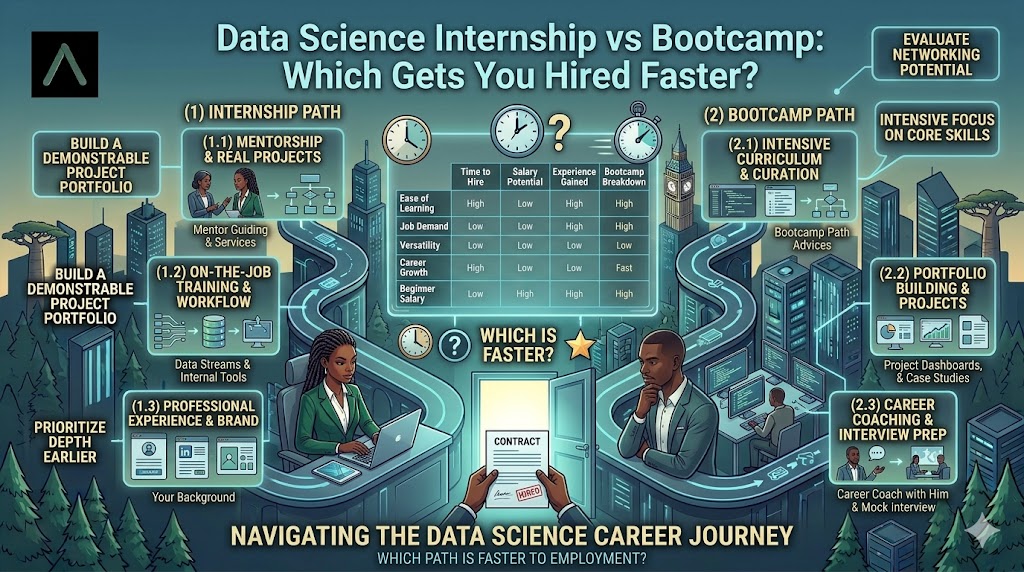
If you want to break into data science, you’ve probably asked yourself a practical question: should you do a data science internship or join a bootcamp? Both can help, but they do very different things.
An internship gives you real work experience inside a company. A bootcamp gives you structured training, projects, and a faster way to build technical skills. So when the goal is getting hired quickly, the better option depends on what you already have, what you lack, and how employers actually hire.
The honest answer is this: internships carry more weight with employers, but bootcamps are often easier and faster to start.
Why this question matters
A lot of aspiring data professionals are not choosing between two perfect options. They are usually trying to overcome one of these problems:
- They lack practical experience
- They do not have strong technical skills yet
- They are changing careers
- They need a faster route into the job market
That is why the internship versus bootcamp debate matters. It is really a question about which path closes the gap between where you are now and where employers need you to be.
What a data science internship gives you
A data science internship is valuable because it gives you something employers trust immediately: real-world experience.
Even if the work is basic, internships show that you have worked with actual business data, deadlines, stakeholders, and team processes. That matters because hiring managers are often less worried about whether you can finish an online course and more interested in whether you can operate in a working environment.
An internship can help you build:
- Hands-on experience with real datasets
- Familiarity with business problems
- Collaboration skills
- Exposure to tools used in industry
- A stronger CV
- References and professional contacts
In many cases, internships also reduce risk for employers. If you have already worked in a business setting, they may feel more confident hiring you into a junior role.
Why internships often lead to faster hiring
Internships tend to help people get hired faster because they answer the employer’s biggest question: can this person do the job in a real setting? Does this person have the necessary skills to handle at least the most basic challenge?
A candidate with internship experience often looks more employable than someone with only self-study and multiple bootcamps, even if the second candidate has done more coursework. Experience creates credibility.
In some cases, internships can even convert directly into full-time offers. And even when they do not, they often make interviews much easier because you can talk about real problems you worked on instead of only personal projects.
What a bootcamp gives you
A bootcamp is usually better for people who need structure, speed, and accountability.
Instead of figuring everything out alone, you follow a guided curriculum that typically covers the core skills needed for entry-level analytics or data science roles. That often includes:
- Python
- SQL
- Statistics
- Data cleaning
- Visualisation
- Machine learning basics
- Portfolio projects
- Interview preparation
For someone starting from scratch, this can be a huge advantage. A bootcamp can help you go from confusion to competence much faster than unstructured self-learning.
Why bootcamps can feel faster
Bootcamps often feel like the faster route because you can usually start one sooner than you can land an internship.
Getting into an internship may require applications, interviews, timing, and competition. A bootcamp is something you can often begin immediately. That means your learning starts faster.
So if you currently have weak technical skills, a bootcamp may be the quickest way to become job-ready enough to apply for data roles.
But there is an important catch: bootcamps teach skills, while internships prove employability.
That difference matters.
Which one gets you hired faster?
In most cases, an internship gets you hired faster if you can get one.
That is because employers value direct experience highly. Internship experience makes your profile easier to trust, easier to shortlist, and easier to discuss in interviews.
However, that does not mean internships are the better starting point for everyone.
If you currently do not have enough technical foundation to qualify for internships, then a bootcamp may actually be the faster path overall because it helps you become competitive in the first place.
So the more accurate answer is this:
- Choose an internship if you already have some technical skills.
- Choose a bootcamp if you need to build those skills first
Choose both, if possible, in sequence. We have helped people with the skills gain real-world work experience through our internship and the numbers speaks for themselves. Click here to watch some testimonials
That combination is often the strongest route.
When an internship is the better choice
An internship is usually the better option if:
- You already know some Python, SQL, or statistics
- You can build basic projects already
- You are a student, recent graduate, or early-career changer
- You want the strongest CV signal
- You want real business experience quickly
If you are already somewhat job-ready, an internship gives you what courses cannot easily replicate: context, credibility, and professional proof.
When a bootcamp is the better choice
A bootcamp is usually the better option if:
- you are starting from zero
- you struggle with self-learning
- you want a clear roadmap
- you need help building projects and a portfolio
- you want career support and interview prep
For many career changers, bootcamps are useful because they reduce overwhelm. Instead of trying to choose from hundreds of tutorials and courses, you follow one path.
Still, it is important to be realistic. A bootcamp certificate by itself is rarely enough. What matters is whether the bootcamp helps you build skills, projects, and confidence that translate into interviews.
What employers care about most
Employers usually care less about the label and more about what you can show.
They want evidence that you can:
- work with data
- solve problems
- explain findings clearly
- use common tools
- contribute in a real environment
That means a bootcamp can help if it leads to a strong portfolio. An internship can help if it gives you examples of real impact. Neither one works well if you come out with vague claims and no proof.
The best strategy for most people
For most aspiring data professionals, the best strategy is not to obsess over which path is universally better. It is to choose the path that removes your biggest weakness first.
If your weakness is skills, do a bootcamp or another structured learning route.
If your weakness is experience, pursue internships or adjacent work experience as aggressively as possible.
And if you can, combine them:
learn the skills, build projects, then use that foundation to land an internship or junior analyst role.
That path is often more effective than waiting for the perfect opportunity.
Want to know how you can take advantage of our internship? Book a free clarity call with our team to be guided.