Important things to know
Somewhere between your third year at a company and your fifth, a quiet panic sets in. You have been performing well. Your reviews are solid. You show up, contribute, stay current. And yet the promotion keeps landing on someone else's desk. Someone who, from where you sit, does not appear to be working any harder than you.
This is one of the most common and least talked-about frustrations in global corporate environments. And the root cause is rarely about competence. It is about habits specifically, the daily behaviours that signal leadership readiness to the people with the power to promote you.
Global companies operate differently from local ones. The decision-makers are often not in your building. The competition for senior roles pulls from multiple countries. The cultural expectations around ambition, communication, and visibility vary widely. In this environment, working hard is table stakes. What separates the promoted from the passed-over is a specific set of habits that most people never consciously develop.
Here is what those habits actually look like and how to start building them.
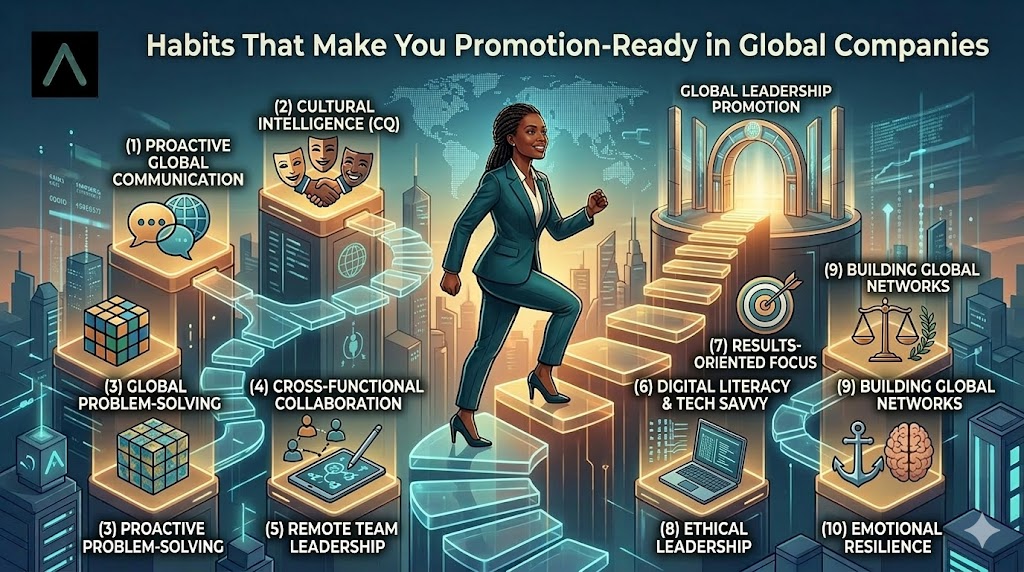
1. You Manage Your Reputation Like a Professional Asset
In a global company, your reputation travels faster than you do. Before you walk into a meeting with a regional director or a cross-functional team in another country, people have already formed an impression of you based on emails you sent, reports you filed, decisions you made in rooms you have long forgotten.
Promotion-ready professionals understand this and treat their professional reputation as something that requires active maintenance. They are consistent not just when leadership is watching, but in every interaction. They follow through on commitments. They communicate clearly and on time. They own their mistakes without drama and correct the course quickly.
The habit here is not about performative professionalism. It is about recognising that in a large, distributed organisation, you are always building your reputation through the quality of your work, the way you handle pressure, and how you treat people who cannot directly help you.
Ask yourself regularly: what is the one-sentence description someone in another department would use to describe me? Is that the sentence that gets people promoted?
2. You Make Your Work Visible Without Waiting to Be Asked
This is the habit that most high-performing professionals resist the longest, often because it feels uncomfortably close to self-promotion. But there is a meaningful difference between bragging and strategic visibility and learning to navigate that difference is one of the most valuable career skills you can develop.
In global organisations, leaders are managing large portfolios of people and priorities. They do not have the bandwidth to track everything you are contributing. If your work is not surfaced through presentations, internal updates, cross-team collaboration, or even well-written progress emails it effectively does not exist at the leadership level.
The professionals who get promoted have learned to share their output proactively: post it, publish it, present it. They volunteer to speak in cross-functional reviews. They write brief summaries after project milestones and share them with relevant stakeholders. They contribute to internal knowledge bases, company newsletters, or team retrospectives in ways that make their thinking and impact visible.
Visibility is not vanity. It is the professional responsibility to ensure that your contributions can be evaluated, built upon, and recognised. Let your work speak even when you are not in the room.
3. You Think “Outcomes, Not Activities”
There is a telling difference in how promotion-ready professionals talk about their work versus how others do. When asked what they have been working on, most people describe activities: meetings attended, tasks completed, processes followed. Promotion-ready professionals describe outcomes: revenue influenced, problems solved, time saved, decisions enabled.
This is not just a communication style. It reflects a fundamentally different way of operating. When you think about outcomes, you naturally start asking better questions before beginning any piece of work: what does success actually look like here? How will we know this made a difference? What would change if this did not get done?
Global companies especially those with matrixed structures and cross-regional teams are ruthlessly outcome-focused. Resources are limited, competition is global, and stakeholders want to see return on everything. The professionals who advance are those who instinctively connect their daily work to measurable business impact.
A useful habit: at the end of every week, write down not what you did, but what changed because of what you did. That shift in framing will gradually rewire how you approach your work and how leaders see you.
4. You Prioritise Productivity Over Activity
Busyness has become a status symbol in modern workplaces. Packed calendars, back-to-back meetings, perpetual responsiveness these things signal effort. But in global companies, effort without output is just noise. The professionals who advance are not the busiest ones. They are the most productive ones, and there is a significant difference. Activity is motion; productivity is progress. You can spend an entire week in meetings, respond to every Slack message within minutes, and fill a notebook with action items and move absolutely nothing meaningful forward. Promotion-ready professionals have trained themselves to ask a harder question before committing to anything: Will this actually move the needle, or does it just feel productive?
Watch this video on “Skills that will get you hired in 2026 and beyond”
In practice, this habit shows up as a ruthless prioritisation of high-leverage work. It means protecting deep work time instead of letting the calendar fill by default. It means saying no or not yet to requests that distract from your most important contributions. It means ending every day not by tallying tasks completed, but by asking: did I move my most important priority forward today?
This is particularly critical in global organisations where the volume of work is relentless and the pressure to appear busy is constant. Senior leaders are not promoted because they responded to every email. They are promoted because they consistently delivered on what mattered most even when everything around them was demanding attention.
At the end of each week, audit your time honestly. How much of it was spent on work that will matter in six months? That ratio is your real productivity score and it is one of the clearest indicators of whether you are building toward a promotion or simply keeping yourself occupied.
5. You Build Upward Relationships Without Being Sycophantic
Promotions, especially in large global organisations, rarely happen in a vacuum. They require sponsors senior people who believe in your potential and are willing to advocate for you when you are not in the room. Yet many professionals either neglect these relationships entirely or approach them in ways that feel transactional and hollow.
The habit of building genuine upward relationships is about adding value before asking for anything. It means sharing relevant insights with a senior leader before they ask. It means volunteering for high-visibility projects that give leadership exposure without demanding recognition in return. It means being curious about their challenges and thinking about how your work can make their lives easier.
Over time, this creates something powerful: a senior person who thinks of you as a solution. And when a role opens up, they think of you first not because you networked aggressively, but because you consistently showed up as someone worth betting on.
Sponsorship is not given. It is earned, quietly, through repeated demonstrations of competence, reliability, and genuine commitment to the organisation's goals.
6. You Are Already Operating at the Next Level
This is perhaps the most counterintuitive habit on this list, and the one that separates the truly promotion-ready from everyone else: they do not wait to be promoted before they start behaving like someone at the next level. They take ownership of problems that are technically outside their remit. They mentor junior colleagues without being asked. They flag strategic risks, not just operational ones. They come to meetings with a point of view, not just a status update. They treat the organisation's challenges as their own, even when they have no formal authority over the outcome.
This habit makes the promotion conversation almost inevitable. Because at some point, a leader looks at what you are already doing and realises that you are already functioning at a senior level — and that not promoting you would be a retention risk.
The title follows the behaviour. Always. Start behaving like the professional you want to become, and the organisation will catch up.
The Honest Truth About Promotions in Global Companies
There is no single habit that unlocks a promotion and there is no perfect checklist that guarantees advancement. Global organisations are complex, sometimes political, and occasionally unfair. Those realities are real but what is equally real is this: the professionals who consistently get promoted in these environments share a common set of behaviours. They manage how they are perceived. They make their contributions visible. They think and speak in outcomes. They choose productivity over activity. They build genuine relationships across cultures and hierarchies. And they operate, every day, slightly above the ceiling of their current role.
These are not personality traits you either have or you do not. They are habits learnable, practicable, and compounding over time. Start with one. Apply it consistently for 30 days. Notice what changes. Then add another. That is how careers are built in global companies, not through a single breakthrough moment, but through the steady accumulation of the right behaviours, repeated long enough to become who you are.
If you are looking for a great opportunity to advance your career as an African immigrant living in the UK, US or Canada, and land tech jobs, we put together a work experience program that can help you work on projects with guidance/mentorship and showcase real business impact to potential employers. This program is for people who have learnt a tech skill and need country-based experience to increase their chances of landing jobs. You can speak to our team to get started here.