Important things to know
If you have ever asked this question: “How do I write a CV when I don’t have any/many years of BA experience to show off?” This article is for you.
Breaking into a new career path like business analysis can feel daunting, especially when you don’t have years of experience to showcase. The truth is recruiters and hiring managers aren’t just looking for domain expertise, they’re also looking for potential, transferable skills, and growth potential. Your CV is your first chance to prove that, and that’s why we’re having this one‑way conversation today.
Through this article, I intend to walk you through how to craft a CV that stands out for entry-level BA roles, whether you’re fresh out of school, transitioning careers, or just starting your professional journey. Think of this as me writing you a letter, sharing the lessons I wish someone had told me when I was starting out.
Let’s take it from the top.
Your CV is not a biography. It’s not meant to capture every detail of your life.
It’s a marketing document. Its job is simply to get you noticed, to get you into the interview room. That’s it.
So when you sit down to write, don’t think: “How do I prove I’ve done everything?” Instead, think: “How do I show I have the skills, mindset, and potential to succeed as a BA?” That shift in perspective changes everything.
A recruiter has over 100 CVs on their desk. They’re not reading word for word what you have written down, they’re scanning quickly, looking for certain keywords. If your CV is messy, cluttered, or hard to read, they’ll move on. So give them a structure that guides their eyes.
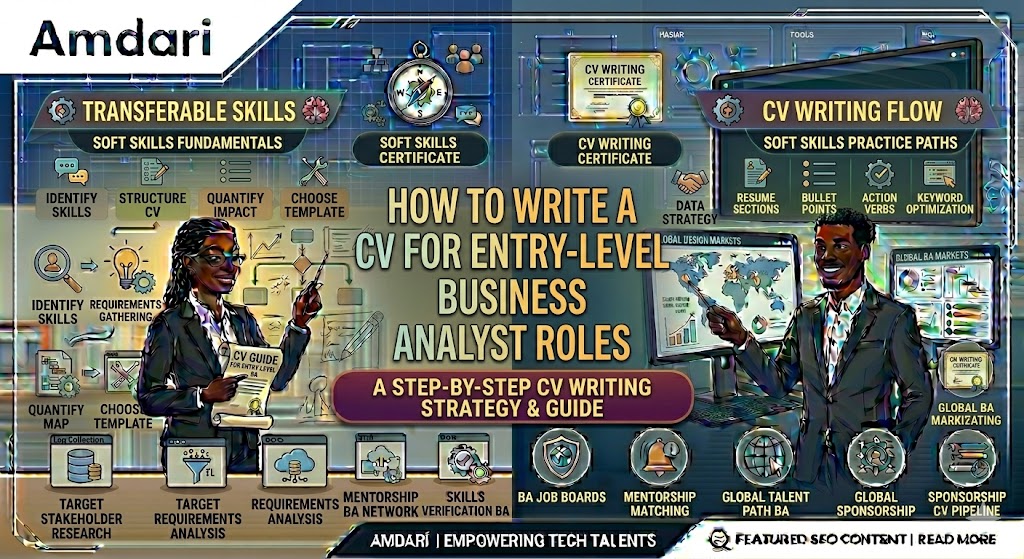
Here’s the flow I recommend:
- Personal Information
- Professional Summary
- Education
- Skills (technical + soft)
- Experience (internships, projects, part-time jobs)
- Certifications & Training
- Projects/Portfolio
Keep it to one or two pages. Think of it as a highlight reel, not a full movie.
Personal Information
This is the very first section of your CV. The goal is to make it easy for a recruiter to identify you and contact you.
It should be clean, minimal, and professional. No long sentences, no unnecessary details, and definitely nothing personal like age, marital status, or home address (those are outdated and not required).
Think of this section as your “business card.”
It tells the recruiter who you are, how to reach you, where you’re based, where they can learn more about your professional profile
- Use a professional email (no nicknames).
- Include LinkedIn and Portfolio links (if any).
- Use hyperlinks. Don’t paste the full link.
- No need for your full home address — city and country are enough.
- No photos unless the country specifically requires it.
Professional Summary:
This is the first thing they’ll read, so make it count. Don’t waste it with clichés like “hardworking team player.” Instead, tell them who you are, what you bring, and where you’re headed.
For example:
“Detail-oriented graduate with strong analytical and communication skills, experienced in gathering requirements through academic projects and internships. Skilled in translating complex data into actionable insights. Seeking to contribute to business improvement as an entry-level Business Analyst.” _Fresh graduates
“Analytical and detail-oriented Business Analyst with [X] years of experience in [current role/industry], skilled in understanding user needs, improving processes, and communicating insights across teams. Adept at gathering requirements, solving problems, and translating ideas into clear, structured documentation. Brings strong collaboration, critical thinking, and stakeholder engagement skills to support effective decision-making and deliver value-driven business outcomes.” _Career Transitioners
See how it’s short, confident, and tailored? That’s the tone you want.
Education:
If you’re entry-level, your education carries weight. But don’t just list your degree but make it work for you. Highlight relevant coursework: statistics, IT, project management, economics. Mention academic projects that mirror BA tasks: process mapping, data analysis, case studies.
If you did a capstone project or thesis, describe it like a mini BA project. That shows initiative and relevance.
If you’re now a fresh graduate, put this section last
Skills:
This is where many people miss it. This is your chance to prove you’ve got the tools to succeed. Split them into two - three buckets:
- Technical skills: List the skills directly related to the role like requirements gathering, elicitation, facilitating workshops, documentations, Agile/Scrum fundamentals, process modelling, etc
- Tools: such as Excel, SQL basics, Power BI, Tableau, Visio, LucidChart, Jira, Confluence, etc
- Soft skills: Communication, active listening, critical thinking, adaptability, relationship-building, negotiation, etc
Remember, soft skills drive 60–80% of project success. Don’t hide them. Make them visible.
If you’re not new to the corporate world, add your skills right after Professional Summary and continue the flow.
Experience:
You’re probably thinking, “But I don’t have BA experience.” That’s fine. The essence of this section is to leverage what you already have. Everyone is a Business Analyst, you just have to tailor it to suit the role.
- Internships: emphasize analysis, reporting, teamwork.
- Volunteer work: highlight organizational improvements.
- University projects: treat them like mini case studies.
- Part-time jobs: customer service shows stakeholder engagement, research projects show requirements gathering.
Use strong verbs: Analyzed, Facilitated, Documented, Collaborated, Led, Monitored, Supported.
Certifications, Trainings & Certificates
Certifications can make you stand out. For entry-level BAs, look at:
- IIBA ECBA, CCBA or CBAP
- BCS Foundations
- SAFe certifications
- SCM for Scrum Mastery.
Certificates from training taken can also show your eagerness to learn and prove that you’ve acquired the necessary knowledge. They show initiative and commitment.
- Agile/Scrum fundamentals.
- SQL or Excel courses.
- Business Analysis bootcamps
- Data visualization tools (Power BI, Tableau basics).
It’s important to know the difference between “certifications” and “certificates”
Projects & Portfolio.
Show, Don’t Just Tell
Recruiters love seeing practical examples. Did you map a process in school? Build a dashboard? Do a case study? Attended an internship like the Amdari RAVE? Put it in.
Example:
“Mapped out a new student registration process, identified bottlenecks, and proposed improvements that reduced wait times by 30%.”
If you’ve got a GitHub, portfolio site, or LinkedIn project highlights, link them. You can start by taking advantage of the cohort-based work experience program to work on projects with real business impacts, build your confidence, gain employability skills and increase your chances of landing jobs, whether you are a career
switcher or African immigrant in the UK, US or Canada. Find out here.
It’s important to know that with your CV, one size doesn’t fit all
Never send the same CV everywhere. Read the job description, pull out keywords, and mirror them in your CV. If the role emphasizes stakeholder communication, highlight that. If it’s data-heavy, push your Excel/SQL skills. Show them you’re paying attention.
Don’t just add these to your skills sections, show how you used them in the experience section too.
Common Mistakes to Avoid
- Overloading with irrelevant details, like
- Using generic summaries.
- Making the CV too long.
- Forgetting to proofread.
In Conclusion, recruiters know entry-level means potential, not perfection. They’re not expecting you to have led million-dollar projects. They’re looking for curiosity, adaptability, and evidence that you can grow.
So don’t wait until you feel “ready.” Start building your CV now. Add that project, list that skill, mention that certification. Each line is proof that you’re serious about becoming a BA and remember that soft skills are the biggest weapons in your arsenal. They’re what make you the BA people want in the room. Communicate clearly, listen actively, think critically, adapt quickly, and build relationships. Put that energy into your CV, and you’ll stand out.
You’ve got this; we’re rooting for you and you can speak with us. Book a free clarity call with our team via this link to receive guidance. Click here.