Important things to know
In the modern business world, two roles are constantly mentioned in conversations about building successful products: Project Management and Product Management. While they sound similar and often work closely together, they serve very different purposes within an organization. Many companies struggle when these roles are misunderstood. Sometimes a project manager is expected to define product strategy, or a product manager is asked to run delivery timelines. When this happens, projects slow down, teams get confused, and products fail to reach their potential.
Understanding the difference between these two disciplines is essential for business leaders, aspiring professionals, and growing startups. Let’s break it down.
Understanding Project Management
Project Management is the practice of planning, organizing, and executing work to achieve a specific goal within defined constraints such as time, budget, and scope.
A project is temporary. It has a clear beginning, a defined objective, and a completion point.
For example:
- Launching a mobile application
- Migrating a company’s data to a new system
- Building a website
- Implementing a new software system
Once the goal is achieved, the project ends.
The role responsible for ensuring everything runs smoothly is the Project Manager.
What Does a Project Manager Actually Do?
A project manager acts as the orchestrator of execution. Their job is to bring together people, processes, and resources to deliver results efficiently.
Typical responsibilities include:
Planning the project
- Defining scope and deliverables
- Creating timelines and schedules
- Establishing milestones
Managing resources
- Assigning tasks to team members
- Ensuring the right people are involved
- Managing budgets and materials
Tracking progress
- Monitoring timelines
- Managing risks and issues
- Keeping stakeholders informed
Ensuring successful delivery
- Making sure the project is completed on time
- Ensuring it stays within budget
- Verifying the final deliverable meets requirements
In short, the Project Manager focuses on execution and delivery.
They ensure the plan works.
Understanding Product Management
While projects focus on execution, product management focuses on value creation.
Product Management is the discipline of guiding a product from idea to market success while continuously improving it based on user needs and business goals.
Unlike projects, products do not end.
They evolve.
Think about products like:
- Spotify
- Netflix
- Uber
- Banking apps
These products are constantly updated with new features, improvements, and enhancements.
Behind this evolution is the Product Manager.
What Does a Product Manager Do?
A product manager is responsible for answering the most important questions about a product:
- What problem are we solving?
- Who are we building this for?
- Why does this product matter?
- What features should we build next?
Their responsibilities typically include:
Defining product vision
They determine the long-term direction of the product.
Understanding the customer: They conduct user research, analyze feedback, and identify pain points.
Prioritizing features: They decide what gets built first and what can wait.
Creating the product roadmap: They outline how the product will evolve over time.
Aligning teams
They ensure engineering, design, marketing, and business teams move toward the same product goal.
The focus of product management is building the right product for the right users.
The Core Difference
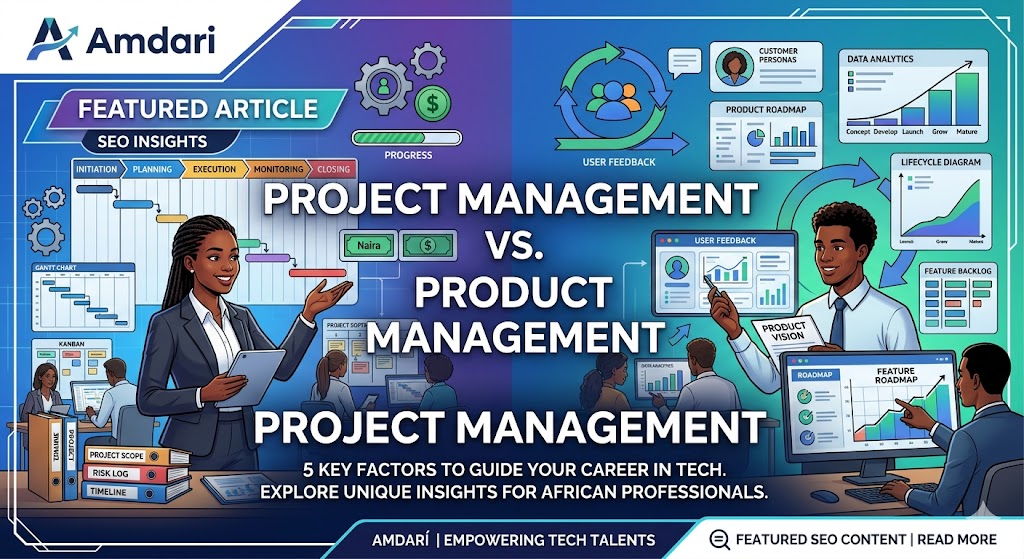
At a simple level: Product Managers decide WHAT to build and WHY.
Project Managers determine HOW and WHEN it gets delivered.
One focuses on product success.
The other focuses on execution success.
Both roles are necessary for organizations to function effectively.
The Product Manager
The Product Manager focuses on the bigger questions:
- What problems are riders facing?
- How can we improve driver matching?
- Should we include wallet payments?
- What features should launch in version 1?
They define the product roadmap and customer experience.
The Project Manager
Once features are decided, the Project Manager steps in to organize execution:
- Creating development timelines
- Coordinating developers, designers, and testers
- Tracking progress
- Managing risks and delays
- Ensuring the product launches on schedule
Both roles work together, but their responsibilities are clearly different.
How These Roles Complement Each Other
Although different, project managers and product managers work best when they collaborate closely.
A healthy workflow often looks like this:
- Product Manager identifies a customer problem.
- Product Manager defines the feature solution.
- Project Manager creates the delivery plan.
- Teams execute the work.
- Product Manager evaluates product performance.
When both roles are aligned:
- Teams stay organized
- Products solve real problems
- Delivery becomes more predictable
This collaboration is particularly important in Agile environments, where product development is continuous.
Skills Required in Both Roles
Despite their differences, both professions require strong leadership and communication abilities.
Shared Skills
- Stakeholder management
- Communication
- Strategic thinking
- Problem-solving
- Team collaboration
However, each role has unique strengths.
Key Strengths of a Project Manager
- Planning and organization
- Risk management
- Scheduling and budgeting
- Process optimization
Key Strengths of a Product Manager
- Customer empathy
- Market research
- Strategic decision-making
- Product vision
Choosing between the two often depends on your natural strengths and interests. You may enjoy Project Management if you like:
- Organizing complex work
- Coordinating teams
- Tracking progress and solving delivery problems
- Ensuring things get done efficiently
You may enjoy Product Management if you like:
- Understanding customer problems
- Shaping product ideas
- Defining product strategy
- Making decisions about product direction
Both careers are highly valuable and in demand across industries.
The Future of Both Roles
As companies become more product-driven, the demand for both roles continues to grow.
Organizations are realizing that successful innovation requires two types of leadership:
- Someone who ensures the right product is built
- Someone who ensures it is built the right way
This balance is what turns ideas into impactful solutions.
Project Management and Product Management may sound similar, but they represent two distinct disciplines that power modern organizations.
Project Managers bring structure, coordination, and delivery excellence.
Product Managers bring vision, strategy, and customer-centered innovation.
When both roles are clearly defined and aligned, teams move faster, products improve continuously, and organizations create real value for their users.
Most people know pretty quickly once they are doing the actual work but you can book a free clarity call with our team here to learn how our work experience internship can guide you get started.