Important things to know
Breaking into data science can feel overwhelming at first. When I started looking into the field, most job descriptions made it seem like I needed to master everything at once machine learning, statistics, big data tools, cloud platforms, and more. It felt like trying to climb a mountain without knowing where the trail even began.
But over time, I realized something important: I wasn’t starting from zero.
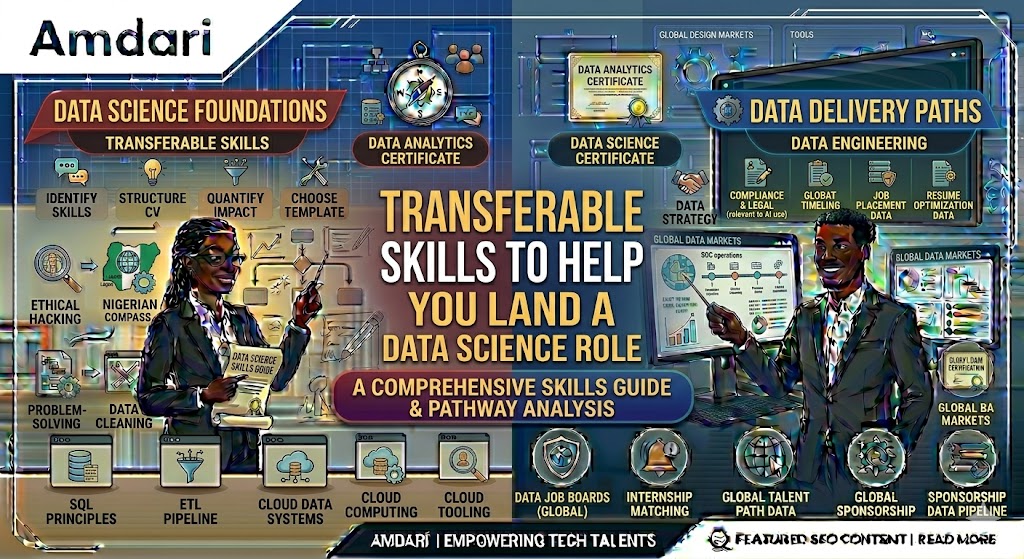
A lot of what makes someone effective in data science isn’t just technical knowledge it’s a set of transferable skills that can come from almost any background. Whether you’ve worked in tech, business, school projects, or even self-taught environments, you likely already have a foundation you can build on.
In this post, I’ll walk through the key transferable skills that helped me (and can help you) position yourself for a data science role and how to actually use them to your advantage.
1. Analytical Thinking
One of the biggest shifts I made was realizing that data science is less about tools and more about how you think.
Before I got deeper into the field, I was already solving problems debugging code, comparing different approaches, figuring out why something wasn’t working. That’s analytical thinking in practice.
Data science simply formalizes that process:
- Breaking problems into smaller parts
- Looking for patterns
- Drawing conclusions from evidence
Employers value this more than people think. You can always learn a new library, but your ability to think critically is what determines how well you use it.
How I Applied This
Instead of just listing tools on my CV, I started explaining:
- What problems I solved
- Why I chose a particular approach
- What insights I discovered
That made my experience feel more practical and less theoretical.
2. Communication Skills
This is one of the most underrated skills in data science.
At some point, you’ll need to explain your findings to someone who doesn’t care about code, models, or technical details. They care about what the results mean and what decisions to make next.
Being able to communicate clearly can set you apart very quickly.
What This Looks Like in Practice
- Writing clear project summaries
- Explaining insights in simple language
- Presenting results without unnecessary jargon
I started improving this by documenting every project I worked on. Not just what I did, but what it meant. Over time, I noticed that I could explain complex ideas more naturally.
And that’s exactly what companies are looking for.
3. Problem-Solving
At its core, data science is about solving problems, not just analyzing data for the sake of it.
Every project should answer a question or address a need:
- Why are users dropping off?
- What factors influence sales?
- How can we improve performance?
What matters is not just your ability to solve problems, but how you approach them.
What Helped Me Improve? I started focusing on:
- Clearly defining the problem before touching data
- Asking better questions
- Breaking large problems into smaller steps
This made my projects more structured and easier to explain.
4. Technical Adaptability
You don’t need to know everything but you do need to be able to learn quickly.
The tools in data science are constantly evolving. Today it might be one framework, tomorrow it’s another. What matters is your ability to adapt.
If you’ve ever:
- Learned a new programming language
- Picked up a framework quickly
- Figured things out through documentation
then you already have this skill.
How I Used This
Instead of trying to master every tool, I focused on:
- Understanding core concepts
- Practicing with real projects
- Getting comfortable learning on the go
This made it easier to pick up new technologies without feeling overwhelmed.
5. Domain Knowledge
This is something many people overlook.
If you’ve worked in any field finance, healthcare, e-commerce, education you already have domain knowledge, and that’s valuable.
Data becomes much more useful when you understand the context behind it.
For example:
- Knowing what metrics matter in a business
- Understanding user behavior in a product
- Recognizing what “normal” vs “unusual” looks like
How to Use It
Instead of building random projects, I started:
- Working on problems related to industries I understood
- Framing insights in real-world terms
- Connecting data results to actual decisions
This made my work feel more relevant and practical.
6. Curiosity
Curiosity is what drives good data work.
It’s the difference between stopping at the first answer and digging deeper to find something meaningful.
In data science, curiosity shows up as:
- Exploring datasets beyond the obvious
- Asking “why” multiple times
- Testing different approaches just to see what happens
How I Developed This. I made it a habit to:
- Go beyond tutorial outcomes
- Experiment with variations
- Investigate unexpected results
This not only improved my skills but also made my projects more interesting.
7. Attention to Detail
Small mistakes in data can lead to completely wrong conclusions.
This is why attention to detail is critical.
In practice, this means:
- Checking your data carefully
- Validating your results
- Making sure your assumptions are correct
What I Focused On
- Double-checking data cleaning steps
- Verifying outputs at each stage
- Being cautious about conclusions
This builds trust in your work—something every employer values.
8. Collaboration
Data science is rarely a solo effort.
You’ll often work with:
- Engineers
- Product managers
- Designers
- Business teams
Being able to collaborate effectively makes a big difference. What Collaboration Involves
- Understanding different perspectives
- Communicating clearly with team members
- Incorporating feedback
How I Improved. I started:
- Working on group projects
- Explaining my work to others
- Being open to feedback and iteration
This helped me become more flexible and easier to work with.
9. Storytelling
This is where everything comes together.
You can have great analysis, but if you can’t present it in a way that connects with people, it won’t have much impact.
Storytelling in data science is about:
- Structuring your findings clearly
- Highlighting key insights
- Connecting results to decisions
What Worked for Me
- Writing summaries for every project
- Focusing on key takeaways
- Asking “so what?” after every result
This helped me shift from just analyzing data to actually delivering value.
One of the biggest mindset shifts I had was realizing that I didn’t need to become someone completely different to get into data science. I just needed to build on what I already had. If you take a step back, you’ll likely find that you already possess several of these transferable skills. The goal is to recognize them, strengthen them, and show how they apply to data science.
A simple way to think about it is this: You’re not starting from scratch you’re connecting the dots between your existing skills and a new field. If you’re aiming to land a data science role, here’s what I recommend:
- Identify your transferable skills
Write them down and be honest about your strengths - Build projects that reflect them
Focus on solving real problems, not just completing tutorials - Document your work clearly
Show your thinking, not just your results - Practice explaining your projects
This will improve both confidence and clarity - Stay consistent
Progress in this field comes from steady effort over time
Breaking into data science isn’t about having everything figured out from the start. It’s about leveraging what you already know and continuously improving.
And once you start seeing your skills from that perspective, the path becomes much clearer.
Want to see some projects that will improve your data science portfolio? Check out some of the projects our data science work experience participants include in their portfolios. You can also take a free 1-minute job readiness test and see what you need to be doing right. Click here to take the test