Important things to know
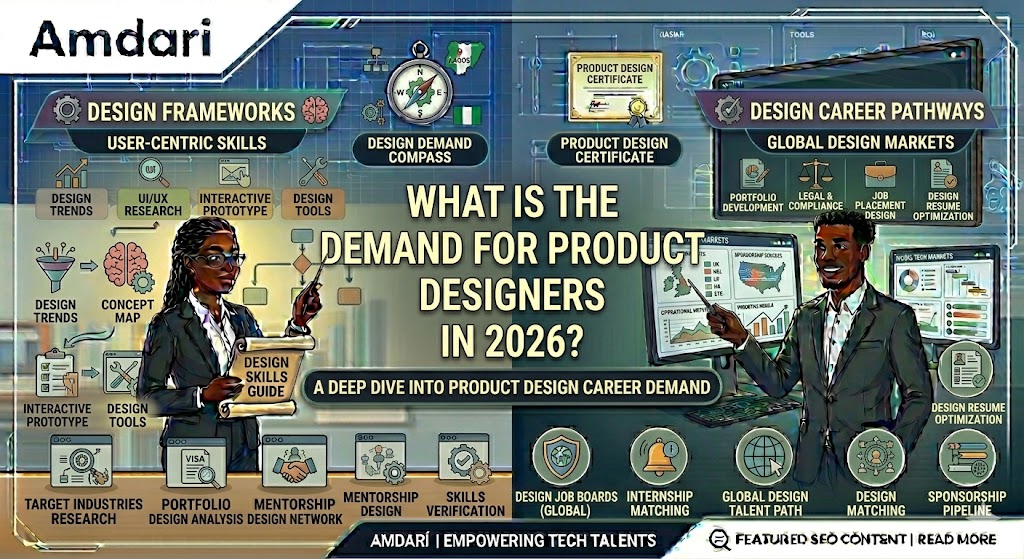
If you’re a product designer right now or thinking of becoming one, you’ve probably asked the question quietly in your head: “Is this field still worth it?”. With AI tools getting smarter, tech layoffs making headlines, and companies tightening budgets, it’s really a fair concern.
Here’s the honest answer: yes, product design demand is still strong/highly-demand in 2026 but it has evolved.
Now let’s have a discussion about what’s really happening, we’ll break it down into sub-sections.
The Product Design Role Didn’t Shrink, It Expanded:
A few years ago, product design mostly meant wireframes, UI screens, maybe some user research if you were lucky, but In 2026? That’s just the baseline.
Today’s product designer is expected to:
- Think in systems, not just screens
- Understand business metrics
- Collaborate deeply with engineers and data teams
- Design with AI in mind
- Ship faster
Companies don’t just want pretty interfaces anymore, they want designers who can influence revenue, retention, and growth. This shift hasn’t reduced demand, It’s made the role more strategic.
AI Didn’t Kill Product Design, It Changed It
When tools like OpenAI popularized AI-powered workflows, many people assumed design jobs would disappear. That didn’t happen or at least it hasn’t happened yet, Instead the following happened or is still happening:
- AI now handles repetitive tasks (layout variations, microcopy suggestions, quick prototypes).
- Designers focus more on decision-making, experience strategy, and problem framing.
- Human empathy became more valuable, not less.
AI can generate screens, It cannot understand why your Nigerian fintech users abandon onboarding at step three. It also cannot sit in a strategy meeting and negotiate product trade-offs. All these are still human jobs and they are very much in demand.
Startups Still Need Designers (Desperately)
In 2026, most startups are leaner, made up of Smaller teams, and also have very tight budgets. This means one thing: They need designers who can do a lot.
A strong product designer today performs the following duties:
- Runs research
- Designs flows
- Builds design systems
- Tests usability
- Tracks product metrics
- Even shapes product roadmap
That “multi-tool” designer is extremely valuable, especially in emerging markets across Africa, Southeast Asia, and Latin America, where digital products are scaling fast and demand is growing faster than supply.
Big Tech Hiring Slowed But Didn’t Stop
Yes, companies like Google, Meta, and Microsoft have become more cautious with hiring compared to the 2021 boom. But here’s what actually changed:
- Fewer junior roles
- Higher expectations
- Stronger emphasis on measurable impact
The demand didn’t disappear, it became more selective. Designers who can show clear case studies, business outcomes, systems thinking and collaboration skills are still getting hired.
The Biggest Growth Areas in 2026
If you want to understand where demand is strongest, look at industries investing in digital transformation. Below are areas product designers are heavily needed:
- Fintech (especially in Africa and Asia)
- Healthtech
- AI-powered SaaS products
- Edtech platforms
- Climate and sustainability tech
- Enterprise tools
Designers who understand complex systems, not just consumer apps are in particularly high demand in 2026.
Remote Work Changed the Talent Game
In 2026, remote work isn’t a perk, It’s infrastructure. This has two big effects:
- Designers in places like Nigeria, India, and Eastern Europe now compete globally.
- Companies hire the best talent regardless of location.
This means more opportunity and competition. Your portfolio really has to stand out beyond geography to be considered for employment/hiring.
What Companies Really Want Now
The most in-demand product designers in 2026 have the following attributes:
- Strong product thinking
- Data literacy
- Systems design experience
- AI tool fluency
- Clear communication skills
- The ability to defend decisions logically
If you’re just focused on UI/aesthetics, you’ll be left out in 2026.
Is the Market Saturated?
At entry level? Yes, it is somehow saturated because bootcamps and online courses produced thousands of new designers in the past few years.
But the same can’t be said for mid-level and senior levels. There’s still a shortage of designers who can lead projects independently and drive measurable outcomes. This gap keeps demand alive.
What’s the conclusion? Is Product Design a Smart Career in 2026? Simple answer, yes if you evolve with it. If you’re still thinking like a 2018-2020 designer (just Figma screens and basic UX), it will feel crowded.
If you think like a product partner, someone who impacts growth, retention, and strategy then you’re stepping into a market that still needs you/other product designers.
Demand in 2026 isn’t about how many designers exist. It’s about how many can:
- Think commercially
- Ship fast
- Adapt to AI
- Own outcomes
In reality, designers who can do the following single-handedly are still smaller that you think and this keeps the demand high. So if you're building your career right now, the real question isn’t: “Is there demand?” It’s: “Am I building the kind of skill set the 2026 market actually rewards?” Take our 1-minute job readiness test to see if you are actually prepared for your next Product Design interview or you are setting up yourself for a rejection email. Take the test here.